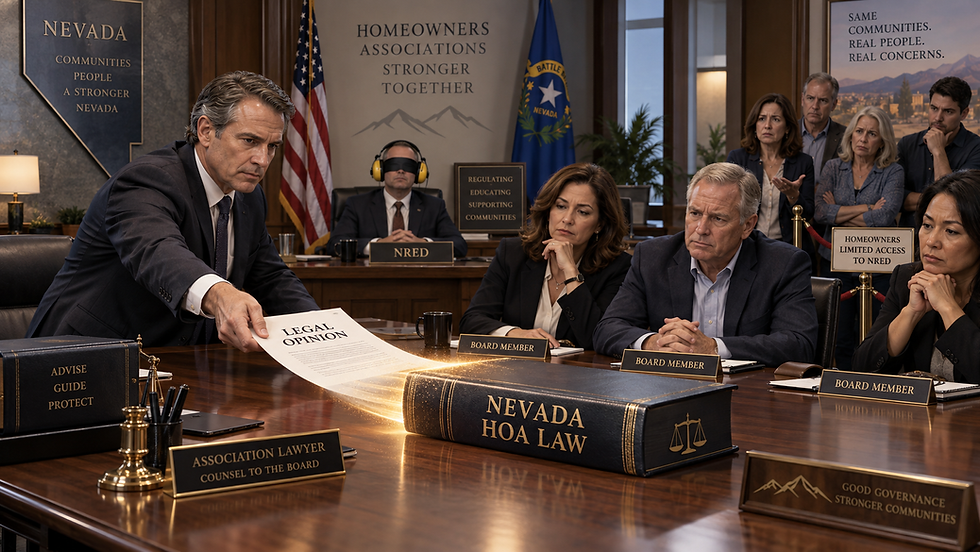
Board’s Theory Lets It Eliminate Its Critic

Challenge Your HOA Board — and You Could Be Disqualified From Serving On It
In full disclosure, I am currently involved in litigation concerning the same basic interpretation of Nevada’s HOA eligibility law discussed below.
The theory is simple — and dangerous.
In my own dispute, association counsel used the “personal profit or compensation” provision (NRS 116.310-34(10(a)(2)) to argue that my pending court appeal challenging the association’s continued developer control made me ineligible to continue serving as one of only two owner-elected directors on a developer-controlled board. That was despite the fact that I was already involved in the litigation when owners elected me—largely because I was willing to fight back.
The Board then went a step further. It deemed itself to have the unilateral authority to make that determination and remove me, regardless of what the owners who elected me wanted.
And my case is not alone.
In at least three other matters involving three different Nevada associations that the Coalition has become aware of—and there are likely more—the same counsel has advanced the same basic theory against owners: an owner disputes association conduct, counsel characterizes that dispute as a personal financial interest, and the dispute itself becomes a basis for excluding the owner from board service.
How the Theory Works—and Is Inexplicably Used by Some Boards
An owner has an unresolved dispute involving conditions affecting his property. Counsel reasons that, if elected, the owner could later participate in board decisions affecting that dispute and could also seek reimbursement of attorneys’ fees if litigation followed. From those possibilities, counsel concluded that the owner stands to gain “personal profit or compensation” and was therefore ineligible to serve.

But each step in that reasoning is problematic. First, a possibility is not an act. The owner had not participated in any conflicted decision; counsel simply assumed what he might do in the future. Second, a potential or actual conflict is ordinarily addressed through disclosure and recusal, not automatic disqualification from office. And third, seeking reimbursement of attorneys’ fees incurred enforcing one’s rights is not “profit” or "compensation" simply because money spent or owed may ultimately be recovered.
Yet those assumptions are combined to produce a very real consequence: the owner is kept off the board- or in my case removed and barred from re-election.
What makes this more troubling is how a theory acquires institutional legitimacy once association counsel puts it in writing. A board can act “on advice of counsel,” even when the underlying legal theory is highly questionable. The problem compounds when NRED then declines to decide whether the board actually had the legal authority it claims, seemingly satisfied merely by the fact that the board obtained advice of counsel. At that point, counsel’s opinion can begin functioning as the practical rule.
That is the larger problem explored here: When Advice of Counsel Becomes De Facto Law and the follow on When “Advice of Counsel” Becomes NRED’s Excuse Not to Decide
Why This Matters
If that theory holds, almost any unresolved dispute with an association — including one created by the board itself — can become a basis for exclusion. An owner challenges an assessment, seeks a declaratory order, disagrees with an architectural decision, records denial, maintenance failure, litigation position, or other board action. If the matter remains unresolved, counsel can argue that the owner might later be an influence as a director and might benefit from the outcome.
At that point, the disagreement itself becomes the alleged conflict.
That should concern every Nevada HOA owner.
Disagreement Is Often Why People Run
People often run for office because they disagree with those already governing. They may believe the board is spending money badly, enforcing rules unfairly, withholding records, mishandling maintenance, pursuing unnecessary litigation, or simply getting the law wrong.
That is not a flaw. It is our cherished system of representative governance at work. It is often the reason elections matter. Yet under this theory, the disagreement itself can become grounds for claiming the challenger has a disqualifying personal interest.
The Board Gets to Eliminate Its Critic
The deeper problem is who gets to decide. Under this theory, the very board being challenged can treat the challenger’s dispute as a reason to exclude that owner from board service. That turns a disagreement over association conduct into a tool for protecting the existing board from one of its critics.That is where the abuse potential becomes clear. The board acts. An owner challenges it. The dispute remains unresolved. The owner runs for the board — or is already serving. The association then says the owner cannot serve or must be removed because the dispute is alleged to create or might create a personal financial interest.
That means the people being challenged can decide whether their challenger is allowed to serve. How can that possibly be?
The Question Nevada Regulators Should Have Answered Long Ago
And that is the question NRED ignores. In my case, a court must now get involved to answer it. That should not be necessary in a properly functioning regulatory system.
The regulator is aware of this position. The question is whether Nevada law allows an association to turn an owner’s unresolved disagreement with the board into complete disqualification from office—and whether the board itself gets to make that determination.
If this theory holds, the message to owners is simple: challenge your HOA board, and the dispute itself may become the reason you are not allowed to serve on it.
And if that is what Nevada law permits, then the law needs to change. As readers of this site have hopefully come to understand, this is hardly the only change Nevada’s HOA system needs—and far too many of those needed changes continue to be ignored.
The Commission’s recent approval of the new health, safety and welfare regulation is another example. Rather than narrowing board discretion, it risks giving boards yet another dangerous weapon that can be used against owners—and NRED led the effort to put that weapon in their hands.
We live in a country where representative democracy is supposed to matter. That principle should not become irrelevant simply because someone buys a home in an HOA. Owners should have the right to elect those who govern them, and an attorney’s opinion followed by a board vote should not be enough to deny or override that choice.
HOA governance should not become a democracy-free zone.