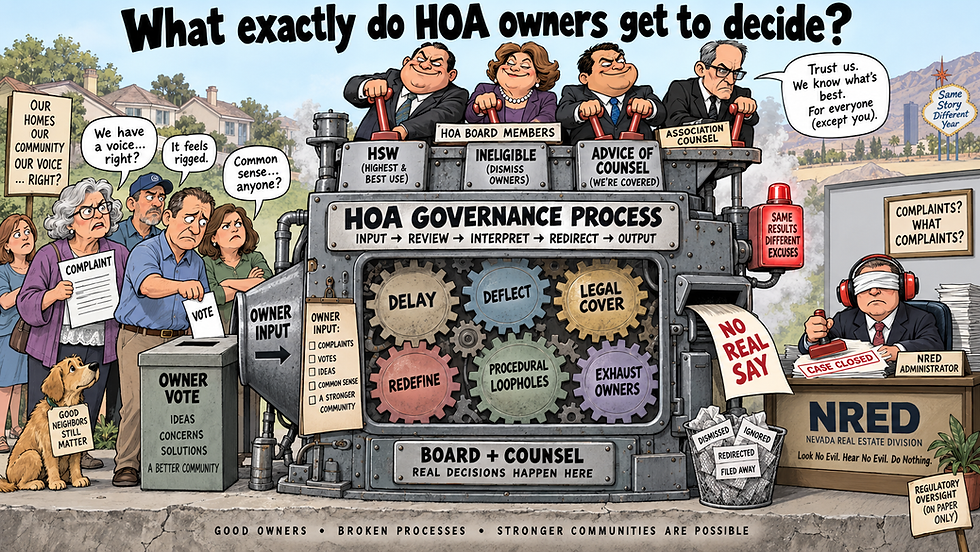
When “Advice of Counsel” Becomes NRED’s Excuse Not to Decide

Nevada HOA boards routinely rely on association counsel. They should. The problem begins when NRED treats that reliance as a substitute for deciding whether the board actually complied with Nevada law.
An owner files a formal complaint alleging that a board violated Chapter 116. The board points to advice of counsel. Rather than independently identify the statutory authority for the board’s action, NRED points the owner back to counsel’s opinion. Case closed.
But notice what never gets answered: Was the board’s action actually authorized by Nevada law?
And we now have current examples in black and white. One involved an owner who later tried to raise the broader policy issue with the CIC Commission, NRED initially rejected her comments as too closely tied to the confidential complaint and later redacted portions describing the factual example and questioning the Division’s reliance on counsel.
NRED declined to resolve the underlying legal question. Then, when the owner tried to show the Commission how that happened, NRED rejected and redacted portions of her comments.
Call it confidentiality if you like. It looks increasingly like censorship.
At the time of this writing, despite her explicit request, NRED had not posted her comments on its website, as it routinely does on request,with other public comments.
The Question NRED Keeps Avoiding
Consider several very different HOA disputes. A board classifies litigation as involving the health, safety and welfare of owners, allowing it to proceed without the owner vote that otherwise would have been required. Another board concludes that an owner is ineligible to appear on the ballot. Another determines that a sitting elected director may no longer serve.
The facts differ. The underlying question does not: Where does Nevada law give the board authority to do that? That is the question a regulator should answer.
Instead, NRED and some association counsel are using “advice of counsel” to sidestep the real inquiry. Rather than determine whether the board correctly interpreted and complied with Chapter 116, NRED can focus on whether the board sought legal advice before acting. Those are not the same thing.
A lawyer may reasonably advise a board that it possesses certain authority. The lawyer may ultimately be right.
But a legal opinion does not create statutory authority—and it should not end the regulatory inquiry. At present, it can and does.
We have examined that problem in greater depth in When Advice of Counsel Becomes De Facto Law and “On Advice of Counsel” Should Begin the Inquiry, Not End It.

The Regulatory Closure Loop
The board asks counsel what it may do. Counsel interprets Nevada law. The board acts. An owner challenges the action. The board points to counsel. NRED treats that consultation as evidence that the board acted on an informed basis. The complaint is closed.
The legal opinion has now become functionally self-validating. The board relies on counsel. The regulator relies on the fact that the board relied on counsel. And nobody independently determines whether counsel’s interpretation of Nevada law was correct.
That is not meaningful regulatory review.
A Second Real-World Example
Sun City Summerlin provides a current example. Its board treated litigation challenging Southern Nevada Water Authority enforcement of Nevada’s turf-removal requirements as a health, safety and welfare matter. That allowed the association to enter the litigation without first obtaining the owner vote otherwise required. When the subsequent owner vote reportedly failed to produce the statutory majority needed for ratification, association counsel took the position that the litigation could nevertheless continue.
Counsel may have a legally defensible interpretation. But who decides whether he is right? That is the issue we examine more fully in our separate article on the Sun City litigation.
Different facts. Same regulatory problem: private counsel supplies the interpretation, while the underlying statutory question remains unresolved.
Someone Has to Decide What the Law Means
Nevada has long recognized the problems associated with forcing HOA disputes into expensive district-court litigation. Most owners cannot afford—or reasonably see little value in—spending years in court simply to discover what Chapter 116 means. That is one reason Nevada has a regulator and a CIC Commission. It is also why NVHOAReform strongly advocates for a meaningful alternative dispute-resolution process.
The regulatory system should provide clarity before every disputed statutory interpretation becomes a lawsuit. Instead, owners increasingly confront this:
The board interprets the law through its attorney.
The owner challenges that interpretation.
The regulator points to the board’s reliance on counsel.
And the legal question remains unanswered.
That is how private legal advice can begin functioning as Nevada HOA law without ever becoming law at all. Bboards should seek legal advice.
The problem is when NRED uses that advice as a reason not to decide.
Because once that happens, the owner is left with a statute, a complaint—and no regulator willing to say what the law requires.