NRED Seeks More Secrecy — Not the Transparency HOA Owners Demand

Nevada HOA owners have spent years asking for greater transparency and accountability from the agency charged with enforcing Nevada’s HOA laws. That agency, the Nevada Real Estate Division (NRED) is now proposing something very different.
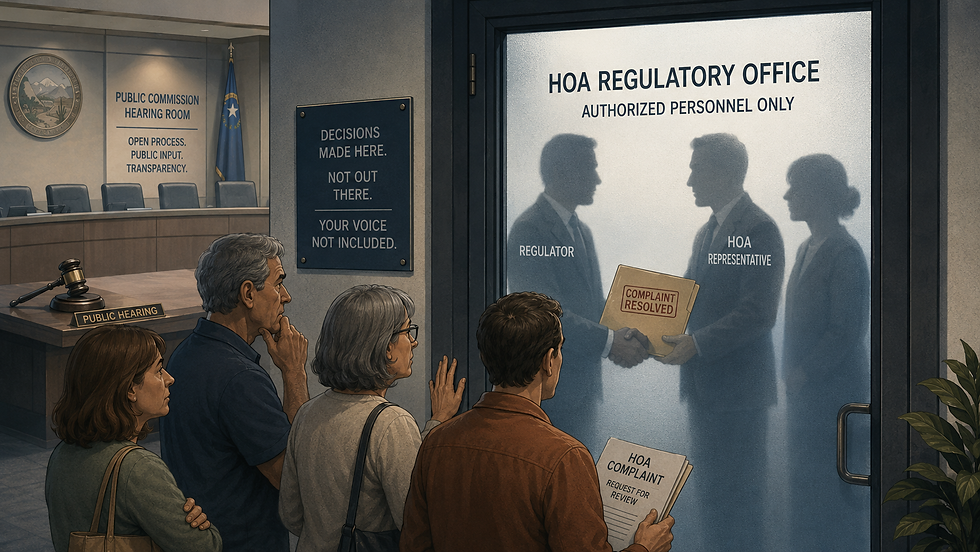
Section 4 of proposed regulation R091-25 would formalize, what NVHOAReform believes is already an informal process, allowing alleged violations of Nevada HOA law to be resolved behind closed doors—without a formal complaint, without a public Commission proceeding, and potentially without owners or even the complainant ever knowing what the Division decided.
That should concern every Nevada HOA owner.
NRED Can Already Recommend Corrective Action
There is nothing wrong with the Nevada Real Estate Division attempting to resolve a complaint without unnecessarily prosecuting every matter before the Commission for Common-Interest Communities and Condominium Hotels. The Division already has the ability to investigate a complaint and recommend corrective action to avoid filing a formal complaint. If an association or other respondant accepts the recommendation and fixes the alleged problem, a hearing can be avoided.
If it refuses, the Division can file a formal complaint and take the matter to the Commission.
So what does Section 4 add?
Secrecy—and regulatory legitimacy for decisions made inside that secrecy.
What Happens When the Association Agrees?
Suppose an owner files a complaint alleging that an HOA violated Nevada law. NRED investigates. The Division concludes that the association is not complying with the law and privately tells the association what it should do to correct the violation.The association agrees.
Problem solved? Perhaps.
But consider what may never happen. There may be:
no formal complaint;
no public Commission hearing;
no Commission finding that the law was violated;
no public explanation of what Nevada law requires;
no public record of the corrective action;
and potentially no disclosure to the owners—or even the complainant—of what NRED determined.
The violation may be corrected, but the regulatory decision disappears. That is the problem Section 4 threatens to institutionalize.
NRED Can Privately Decide What Nevada Law Means
This is more than a question of whether an investigation remains confidential. In order to tell an association what it should do “to be in compliance,” the Division must necessarily make a judgment about what Nevada law requires. But if the association accepts NRED’s recommendation, that interpretation may never reach the Commission.
NVHOAReform challenged the breadth of that secrecy more than a year ago. NVHOAReform submitted a formal rulemaking petition (see A1) seeking clarification of what we believe is NRED’s excessively broad interpretation of the confidentiality provisions governing complaint investigations—including the extent to which the Division may keep complaint outcomes and its substantive determinations from the public. Read more: The Secrecy Wall: Regulator’s “Confidentiality” Undermines HOA Accountability and Trust
That petition has never been brought before the Commission. Despite the statutory process for rulemaking petitions, NRED has for more than a year declined to place the issue before the body whose regulations and enforcement policies are directly implicated- but argues it has not violated Nevada law. If the Division can prevent a petition from ever reaching the Commission—or leave it unresolved indefinitely—the statutory right to petition for rulemaking loses its practical meaning. Read the August 13, 2026 letter to NRED.
That history makes Section 4 particularly troubling. The Division is now seeking to formalize a confidential informal-resolution process while an unresolved petition challenging the scope of that very confidentiality remains outside Commission review.
Before expanding confidential enforcement, the Commission should first decide how much of NRED’s complaint decision-making is lawfully entitled to remain secret.The Commission never decides whether NRED was right. The public never sees the interpretation. Other homeowners cannot rely upon it. And no one can determine whether the same legal standard is being applied consistently to other associations.
Section 4 therefore risks allowing NRED to accomplish privately what would otherwise require a formal complaint and a Commission determination.
The Division’s confidential interpretation becomes, in practice, the operative interpretation of Nevada HOA law for that case.
Consider the Potential for Abuse
Imagine that NRED receives a complaint involving an association represented by people who have a close or friendly working relationship with the Division. NRED concludes privately that the association violated Nevada law. Instead of filing a formal complaint, NRED privately tells the association how to correct the problem. The association complies.
The matter is closed. The owners never know their association was found out of compliance. The Commission never learns of the matter. The Commission never reviews NRED’s legal interpretation or the resolution. And the public has no way to determine whether another association—or another homeowner filing the same complaint—would receive the same treatment.
The concern is not an allegation that this will occur in every case. The concern is that a regulatory system should not be designed so that it can occur without anyone outside the Division knowing.
Transparency - and the Commission structure - exists precisely because government decision-making should not depend upon public trust alone.
The Opposite Problem May Be Even More Important
Now consider what happens when NRED reaches the opposite conclusion. An owner files a complaint. NRED investigates. The Division decides that the challenged conduct does not violate Nevada law. The complaint is closed. No formal complaint is filed.
Under the Division’s current interpretation of the confidentiality provisions, the investigative materials—and even the substance of the outcome—remain confidential. That means NRED has effectively interpreted Nevada law without the Commission ever considering or reviewing the issue. And that interpretation can influence how the Division handles the next complaint. And the next one. And the next one.
The result is an effectively operative interpretation of Nevada HOA law that develops in secret, while complainants, owners, and the public are left in the dark. I respectfully suggest that this is not merely a hypothetical concern. It is already having detrimental effects.
Section 4 would formalize and expand the very process that permits it.

A Body of Secret, Unwritten HOA Law
Over time, confidential determinations can begin functioning like a body of unwritten regulatory law. Association attorneys and management companies that regularly deal with NRED may learn what the Division will accept and what it will reject. Division investigators may know how similar complaints were resolved previously. But the homeowner does not. The public and lawmakers do not. And in many instances, the Commission itself may never have ruled on the underlying legal question.
Think about the imbalance that creates.
An HOA industry participant who interacts regularly with NRED can accumulate years of practical knowledge about how the Division interprets Nevada law. An individual homeowner filing a complaint may have access to none of it. One side learns the rules through repeated private interaction with the regulator. The other side is left trying to determine what the rules are from statutes and regulations that may not reflect how NRED is actually enforcing them.
That is not meaningful transparency.
It Also Bypasses the Commission
There is another institution that should be concerned about Section 4: the Commission itself.
If disputed interpretations of Nevada HOA law are repeatedly resolved through confidential Division investigations and private corrective measures, those issues never reach the Commission. The Commission loses the opportunity to:
determine publicly what the statute means;
establish a consistent statewide standard;
review whether NRED’s interpretation is correct;
provide guidance to homeowners and associations; and
create a public regulatory record.
Instead, the Division’s interpretation gains influence precisely because the Commission never gets the opportunity to review it. That turns the statutory enforcement structure upside down.
Informal Resolution Is Not the Problem
There is value in resolving minor violations quickly. Not every complaint needs a contested Commission hearing. An association or owner that made an innocent mistake should ordinarily have an opportunity to correct it. That is not what is at issue.
The question is whether the legal interpretation and regulatory outcome should disappear with the settlement. They should not.
Nevada can preserve legitimate investigative confidentiality without hiding from the public what standards its regulator is applying. At minimum, closed matters involving informal corrective action should result in a publicly available, appropriately redacted summary identifying:
the law or regulation at issue;
the general conduct alleged;
whether NRED determined corrective action was warranted;
the general corrective action taken; and
the basis for closing the matter without a formal complaint.
Names and legitimate investigative information can remain protected. The law being applied by a Nevada regulatory agency should not.
Ask Why NRED Wants More Secrecy
Nevada HOA owners have repeatedly asked for greater accountability from the system created to protect them. Section 4 moves in the opposite direction. The Division already has the ability to encourage voluntary compliance. So the Commission should ask a very simple question: What problem requires giving that existing practice additional regulatory authority while allowing the resulting determinations to remain secret?
If NRED determines that an association violated Nevada law, owners should not have to guess what happened.
If NRED determines that conduct is lawful, homeowners should not have to file complaint after complaint only to discover that NRED has privately adopted an interpretation the Commission has never reviewed.
And Nevada should not allow a body of effectively operative HOA law to develop behind closed doors. Owners need more transparency from NRED—not another regulation institutionalizing secrecy.
Send Your Comments to NRED
Public comments may be emailed to: PublicComments@red.nv.gov
You may also review the proposed regulation and related materials on the Nevada Real Estate Division website here. The Division’s workshop notice also identifies the following contact for proposed-regulation materials:
Shareece Bates
Nevada Real Estate Division
3300 W. Sahara Avenue, Suite 350
Las Vegas, Nevada 89102
(702) 486-4036
When submitting comments, identify the proposal as: LCB File No. R091-25 — Section 4
Here is what I have submitted in opposition


