HOA Regulator's Secret Exercise

Nevada's HOA regulator is using confidentiality broadly, making substantive violation and compliance decisions outside the public process lawmakers established, and is now seeking regulatory authority to continue the practice.
Evidence continues to come to NVHOAReform from owners across Nevada showing that the Nevada Real Estate Division (NRED) is exercising authority lawmakers did not give it. It is my assessment, this is not merely the aggressive use of regulatory discretion. Rather, the continuing exercise of Division authority outside the jurisdiction Nevada law established.
As described below this practice is affecting key owner protections, regulatory transparency, and is moving enforcement in the wrong direction. It should be alarming to owners and demands reform.
Nevada law draws the line plainly. Under NRS 116.750, “the Division and the Ombudsman have jurisdiction to investigate” while “the Commission and each hearing panel has jurisdiction to take appropriate action against any person who commits a violation.”
NRS 116.765 then tells us how that process is supposed to work. NRED investigates to determine whether “good cause exists to proceed with a hearing.” If NRED determines the allegations are not frivolous, false or fraudulent and that good cause exists, the Administrator “shall file a formal complaint with the Commission and schedule a hearing” before the Commission or a hearing panel (underline added). This is not discretionary language.

At that point, the dispute is no longer simply an owner challenging an HOA or its board. The State has taken up the matter. The owner supplied the allegation and some evidence. NRED investigated. Adjudication now belongs to the Commission or hearing panel with prosecution led by the State-typically the Attorney General’s office.
The State taking up the action is a critical element. This process serves as a cornerstone of the enforcement structure Nevada lawmakers put in place decades ago to reduce the need for expensive civil litigation—an alternative owners in most other states do not have. That is the jurisdictional structure lawmakers created.
NRED is crossing the line. It is identifying conduct it considers a violation but choosing not to bring a formal complaint and instead issuing private “guidance” or "Letters of Instruction" that can operate like an adjudicatory determination backed by the threat of formal enforcement if the association does not comply.
It could also, in secret, do effectively nothing. That is the larger problem. Secrecy does not erase legal limits, but it can make them almost impossible to test. When the investigation, legal conclusion, remedial decision and closure all remain confidential, owners cannot know whether NRED acted consistently, whether it exceeded its authority, whether the remedy was adequate, or whether similar cases are being treated the same way. The Commission may never see the case. Lawmakers may never know a pattern exists. And the public has no record against which to measure the regulator’s conduct.
That is why this is not merely a dispute over administrative discretion. It is a transparency and accountability problem built into the exercise of regulatory power.
Recent Evidence
An owner filed a formal complaint with NRED. It alleged eight violations of Nevada HOA law by the association’s executive board and board president in early 2026. In August 2026, NRED informed the complainant that the Division had “found there to be violations” related to six of the allegations. The letter closed with:
“Please note the Division has taken the necessary actions in the handling of these matters.”
The Division then invoked NRS 116.757 and told the complainant that no further information regarding the investigation could be disclosed.
On the same day, NRED sent the HOA—but notably not the complainant—what it labeled a “Letter of Instruction". NVHOAReform reviewed a copy of the LOI provided by a source with direct access to the association’s records. The letter acknowledged Division findings of violations relating to several allegations. Yet its operative instruction was essentially this:
"This correspondence will serve as notice by the Division that if such conduct should occurred again, the Division may initiate a complaint for disciplinary action before the Commission [for the three violations noted]".
That matters because several violations were not just adminstrative errors of improperly noticed board meetings. They involved meeting at which the board took actions many owners opposed. NRED found violations. But there was no Commission adjudication. No order requiring the board to revisit or undo the actions taken at those improperly noticed meetings. No apparent fine or sanction. And importantly, no public ruling establishing that the resulting board actions were invalid.
The board acted through meetings NRED found unlawful, yet the resulting actions remained in place—including expansion of the board from three to five members, all despite the community manager’s advice to the contrary—and the board suffered no apparent consequence. NVHOAReform was told the board represented to onwers that the NRED investigation had exonerated it. Yet the Division’s own correspondence, to inlcude its LOI, said it had found violations. Because the complainant and other owners were denied access to the same information provided to the association, they had little ability to test or challenge that representation. Then NRED closed the case. So what exactly where the “necessary actions”?
The problem cuts both ways. NRED can privately prescribe what it considers corrective action without Commission review—or, as this case illustrates, find violations, do little or nothing to correct their consequences, and still close the matter outside Commission review. In many complaints, the closure is even more direct: NRED simply concludes that no violation occurred. The owner is then left with little or no explanation of how the Division reached that conclusion, what facts it accepted, or how it interpreted the law—and no meaningful way to test NRED’s conclusion. That may be the single most common frustration owners bring to the CIC Commission and the Coalition seeking reform
We and the complainant who reached out to the Coalition for help, asked the NRED Administrator for a meeting to discuss what happened. We received no response.
This Matters
Filing a formal NRED complaint is not a casual act. In most cases owners believe they have been adversely impacted by actions of their associations or other owners. They gather records, identify alleged statutory violations, prepare affidavits, respond to investigators and often wait months for an outcome. Yet after doing all of that, the owner may receive little more than notice that the case was opened then closed. We at the Coalition have heard this from HOA owners for years. It appears to occur at an alarming rate and likely holds the top spot of dissatisfaction with the Ombudsman. The CIC Commission hears this during most every quarterly meeting during public comment.
Meanwhile, the association’s board and its counsel may know what NRED objected to and what the Division expected in response. The complainant is never told the same. Other association owners know nothing. Associations then use the confidential label, even after the case is closed, to block efforts around transparency- even to its own owners.
NRED finds violations. The board actions can remain. The owners received no remedy or transparency. The board may suffer no apparent consequence. Closing a case is not the same thing as correcting a violation.
When NRED privately decides what conduct violated the law and what response it deems sufficient, absent oversight, the statutory roles have effectively been reversed. The investigator has moved into adjudication while the body lawmakers gave jurisdiction to “take appropriate action” and approval regulations with the objective of advancing Nevada’s HOA law, not only never hears the case it may never know the violation and remedial action(s) ever occurred.
Now NRED Wants to Formalize That Process in Regulation
That brings us to a year-long regulatory effort by NRED—R091-25—most Nevada HOA owners have probably never heard of. The proposed regulation covered several key HOA issues. Section 2 gives volunteer HOA boards a Health, Safety and Welfare fine authority absent any upper limits. This is discussed in one of our most widely read posts: A Dangerous New HOA Weapon — and Owners Are the Target

But Section 4 of the proposal is also important. Section 4 of the regulation quietly received Commission approval and, once recorded, would expressly authorize NRED during an investigation to identify “remedial measures” that a person or association may take to come into compliance. The regulation seeks to disguise remedial measures as not being a disciplinary action while at the same time saying failure to take them may be considered good cause to proceed to a hearing. All of this is done in secret.
If NRED tells an association what measures will bring it into compliance and refusal can help trigger formal enforcement, the Division has moved beyond determining whether good cause exists. It is applying its own compliance judgment before the Commission ever hears the case.
So the process looks like this:
NRED investigates → identifies a violation → privately prescribes a remedy → the association complies → the case closes → the Commission never adjudicates it → owners may never know what happened.
It should also not be lost to the reader, Section 4 did not create that practice from scratch. It is giving regulatory legitimacy to a practice the evidence indicates NRED is already using.
Informal Resolution Is Not Per Se a Problem
NRED may argue that Section 4 simply creates an informal-resolution process typical of most regulators. To be clear, informal resolution itself is not the problem—and NRED is not a typical regulator. Nevada law already assigns informal resolution to the Ombudsman, then directs NRED to investigate whether “good cause” exists for a hearing and, if it does, directs the Administrator shall file a formal complaint. Section 4 would allow another confidential resolution stage to occur after that structure, while NRS 116.757 keeps the process from meaningful public scrutiny. Administrative efficiency may explain one reason why NRED wants that authority. It does not answer where the authority comes from, nor does it tell the whole story.
The troubling question is not what happens when an association refuses NRED’s suggested corrective action. In that event, NRED can proceed with a formal complaint and put the matter before the Commission. The more important question is what happens when the association agrees. Section 4 allows the matter to be resolved inside the confidential investigation, meaning the Commission may never see the case, owners may never know what NRED found or what was agreed to, and no public decision is created.
Refusal can produce public oversight. Agreement can make the entire matter disappear from public view.
Even if we accept NRED's characterization this is an informal resolution confidentiality under NRS 116.757 shields NRED’s legal conclusions and remedial decisions from review. As owners now complain, those decisions cannot be tested. Who checks whether the same conduct is treated the same way from one complaint to the next, or whether the remedy was adequate—or meaningful at all? Informal resolution still requires oversight. Section 4 creates dangerous room for NRED, the board and the association’s counsel—counsel selected and contracted by that board—to work out a confidential resolution while the Commission and owners never see the case. Owners never know what was found, what was negotiated, what the association agreed to do, or whether the resulting “remedial measure” adequately addressed the violation.
That is not merely secrecy between NRED and a complainant. NRED’s confidentiality interpretation creates secrecy between an HOA board and the owners it governs.
Lawmakers, regulators and the public also lose the ability to see whether the same problems are appearing again and again. A statutory violation can happen with no published decision warning boards or owners where the line is. As the case discussed in this post demonstrates, the underlying action taken through unlawful conduct may remain fully intact.
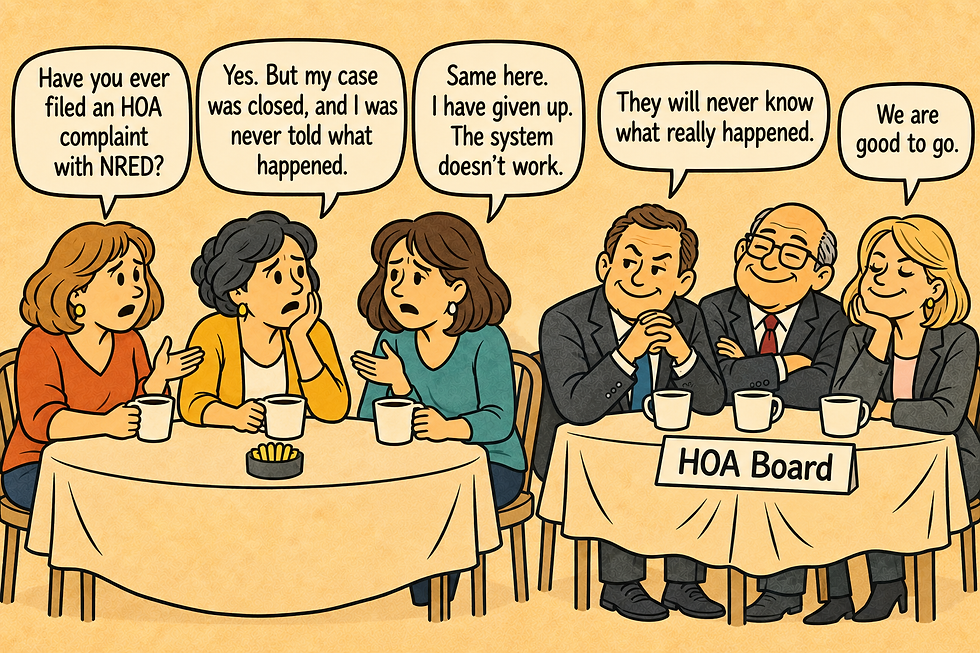
Without that explanation, the owner learns something else instead: filing a complaint may require substantial effort while producing little information and no visible result. That discourages participation in the very enforcement system lawmakers created for owners to use. And when owners stop filing complaints because they believe nothing will come of them, fewer violations reach the regulator, fewer patterns become visible, and the apparent absence of complaints can itself create the misleading impression that the system is working.
HOA owners are being taught to “check out.”
It turns the complaint process on its head. The regulated party can receive the benefit of the regulator’s legal and compliance guidance. It is motivated to engage so as to avoid public sanctions—or any sanction at all—while the person who exposed the alleged violation is left trying to determine what happened.
These concerns were not raised after the fact. NVHOAReform submitted a written opposition during the R091-25 rulemaking process addressing Section 4 and the risks of confidential remedial action. That letter is available on our Rulemaking page.
Where R091-25 Stands
R091-25 has been adopted by the CIC Commission but has not yet received final Legislative Commission approval. So Section 4 is not final. That gives owners, lawmakers and the Commission an opportunity to examine what it would actually institutionalize.
The practice itself, however, is not waiting. NRED is already exercising authority beyond the investigative role Nevada law gives it. Section 4 would help make that practice official. Before Nevada does that, owners deserve to know exactly what authority NRED believes it is exercising—and why.
If NRED Believes This Is Proper, It Should Say So
But its silence is telling.
Perhaps NRED believes this approach is a lawful exercise of administrative discretion. Perhaps it believes informal correction is faster, cheaper or a better use of limited enforcement resources than bringing every substantiated matter before the Commission. Perhaps it believes a private Letter of Instruction or other remedial action can achieve compliance without the delay and expense of a formal hearing.
Those are arguments NRED could make. But that is not what owners have been given and we find no indication in the CIC Task Force’s published 2026 agenda materials that this issue is being examined by the Task Force—the body charged with studying issues affecting common-interest communities and recommending needed legislative or regulatory action. Instead, the practice has largely remained behind the same confidentiality wall NRED applies to its investigations. There has been no meaningful public explanation of when NRED may determine that corrective action is warranted but nevertheless decline to file a formal complaint as the law requires, what statutory authority permits it to impose or negotiate that corrective action, or what standards govern those decisions.
That matters because administrative efficiency cannot itself create statutory authority. Nor does confidentiality answer the underlying question of who lawmakers empowered to determine violations and order corrective action.
The next CIC Commission meeting is scheduled for December 8–10, 2026. No Legislative Commission meeting to consider codifying R091-25 is presently scheduled.
Here is an opportunity for owners to demand transparency and modifications to the regulation the Commission approved without any meaningful discussion of the ramifications noted in this article.
Section 4 is not final. But the practice it would authorize is apparently already underway while the evidence indicates NRED has been using this approach for some time. Before Nevada gives that practice regulatory legitimacy, lawmakers, the Commission and owners should know exactly what authority NRED believes it is exercising—and why.