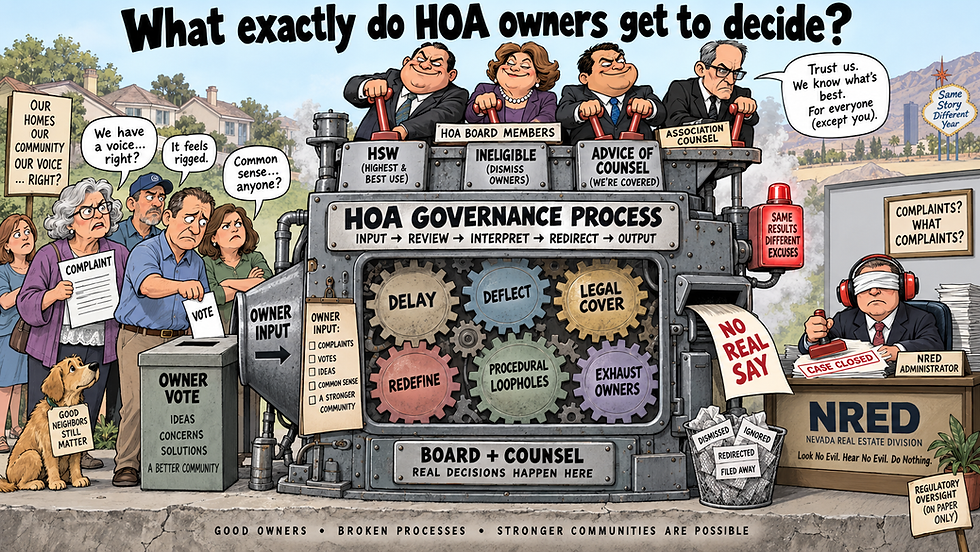
HOA Reform Must Address Structure, Not Just Symptoms

Deborah Goonan of Independent American Communities has published an important article that every homeowner, legislator, regulator, and HOA policy stakeholder should read: “Bold Legislative Reform is needed to rein in HOAs.” (Independent American Communities)
Her central point is one NVHOAReform strongly supports: meaningful HOA reform cannot be limited to minor procedural changes. It must address the structural imbalance of power between HOA boards, developers, managers, attorneys, and individual homeowners. It also requires owner rasie their voices.
That imbalance is the reason NVHOAReform has placed such importance on Nevada’s CIC Task Force, the ongoing regulatory workshops of the CIC Commission, and the need for the Nevada Real Estate Division, the Ombudsman’s Office, and the Commission to make Nevada’s statutory system work in practice—not just on paper.
Deborah identifies several bold reforms, including eliminating HOA fines, severely limiting HOA foreclosure, restricting private-home covenant enforcement, and ending developer control. Her article argues that these changes would reduce the ability of HOAs to bully and intimidate homeowners into submission.
But Deborah’s larger point is exactly right.
The problem is not simply that some HOA boards behave badly. Most do not. The deeper problem is that the legal structure gives associations enormous power over homeowners, including assessment authority, lien rights, enforcement powers, architectural control, access to association funds, and the ability to use attorneys and managers against individual owners. When that power is combined with weak oversight, unclear rules, limited transparency, expensive litigation, and homeowner fear of retaliation, abuse becomes predictable.
NVHOAReform does not necessarily advocate every reform in precisely the same form. For example, Nevada already has an administrative process for statuatory issue, and the issue is not that every fine must disappear, but fines should be available only under clearer standards, stronger due process protections, neutral review, and meaningful limits on board discretion. Likewise, developers may need some continuing control during the early stages of a common-interest community. After all, they have capital at risk, infrastructure to complete, lots to sell, and development obligations to satisfy. But Nevada law already recognizes and protects those interests and needs through declarant rights and special declarant rights. What should not continue is prolonged developer control of the governing board itself. Board control by the developer should be eliminated or, at minimum, strictly limited to a short initial period. It certainly should not be allowed to extend for decades, as some Nevada communities are experiencing.

Nevada is fortunate in one respect. Unlike many states, Nevada has at least the outline of a regulatory and dispute-resolution system. We have an Ombudsman’s Office. We have NRED.
We have the CIC Commission. We have statutes governing meetings, records, elections, fines, assessments, reserves, rule enforcement, and board duties. We also have an administrative enforcement structure that is not supposed to leave every homeowner trapped in the damage-oriented civil litigation system that owners in many states face.
But having a system on paper is not enough.
A regulatory system that does not clarify the law, does not timely address rulemaking petitions, does not provide homeowners with meaningful neutral determinations, or allows serious structural problems to remain unresolved will not protect owners simply because it exists. If Nevada’s system is going to justify confidence, it must function as a real public-interest framework—not merely as a process owners are told to navigate before being left to fend for themselves.
That is why the CIC Task Force matters. That is why the Commission’s regulatory workshops matter. That is why homeowners should be paying attention now.

Nevadans cannot stand on the sidelines while industry participants, association attorneys, managers, developers, and agency insiders shape the future of common-interest community governance. Homeowners have the most at stake. Their homes, assessments, voting rights, property rights, and financial security are directly affected by the rules being written and the rules being ignored.
Deborah Goonan’s article is a reminder that reform must be structural. Better notice forms, cleaner procedures, and more training may help, but they will not solve the core problem if the underlying power imbalance remains untouched.
Nevada may be arguable the best, but that is not good enought and it has an opportunity to do better. The question is whether our policymakers, regulators, and homeowners will use that opportunity.
Read Deborah Goonan’s article here: “Bold Legislative Reform is needed to rein in HOAs”
Independent American Communities